
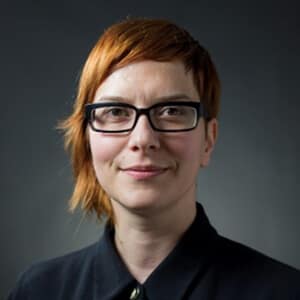
Theodora Katsila

Job Title:
Research Associate Professor
Company - Organization:
National Hellenic Research Foundation
Experience:
18 years
Education:
PhD
Universty - College:
University of Patras
Nationality:
Greek

Your organization field and mission:

NHRF advances interdisciplinary science, translational research, and AI-enabled innovation for societal benefit and sustainable development.

Please tell us briefly about your role in the company / at your organization:

I lead an interdisciplinary research laboratory at NHRF, where we integrate computational science, biochemistry, and bioengineering to accelerate innovation in healthcare. Launching the IN3© framework, my team develops AI-driven biomarker discovery strategies and translational solutions that bridge fundamental science with real-world clinical impact. I am passionate about empowering young scientists and advancing research that serves society.

Your interest in STEM

My interest in STEM was born very early, driven by curiosity rather than a specific career plan. As a child, I was fascinated by understanding how things work — from biological systems to patterns in nature. During school, chemistry and biology became my way of making sense of the world, while mathematics gave me the language to describe it.

Over time, I realized that science is not only about knowledge, but about solving real problems that affect people’s lives. That realization transformed curiosity into purpose. Today, my passion lies at the intersection of sciences, where we can translate scientific discovery into tangible societal impact.

My first role model was not a single famous scientist, but my mum, who showed me that science is all about asking bold questions and my dad, who shaped the way I see research; craving for brainteasers. I have been inspired and still am by Marie Sklodowska Curie, while I have been deeply influenced by Friedrich Nietzsche. Mme. Curie was radically committed to knowledge. Her intellectual discipline, resilience, and refusal to accept imposed limits shaped my understanding of scientific responsibility and ambition. Friedrich Nietzsche insisted on intellectual independence. Scientific breakthroughs require the willingness to dismantle outdated paradigms and construct new ones with rigour and accountability

Your studies

During my studies, one of my biggest challenges was navigating interdisciplinary thinking in environments that were often structured within rigid disciplinary boundaries. I was deeply interested in connecting biochemistry, computation, and systems thinking at a time when such integration was not always encouraged. This sometimes meant pursuing unconventional paths and defending ideas that did not fit neatly into traditional frameworks.
At the same time, these challenges became strengths. They pushed me to develop independence, intellectual courage, and the ability to build bridges across fields; qualities that now define my leadership and research approach.

My two cents to the youth: Be intellectually fearless. STEM fields need your perspective, your questions, and your way of thinking.
Do not shrink yourself to fit existing systems. Learn the rules, master them, and then question them responsibly. Seek mentors, build alliances, and surround yourself with people who elevate your thinking rather than limit it. Most importantly, remember that competence builds confidence, not the other way around. Invest in your skills, stay curious, and do not apologize for ambition. Science advances through bold minds, and you are fully entitled to be one of them.

You at work

At NHRF, diversity and inclusion are embedded in our research culture through merit-based recruitment, equal opportunity policies, and active participation in European frameworks that promote gender equality and responsible research. NHRF supports interdisciplinary collaboration across institutes and encourages international mobility, fostering a diverse and globally connected research environment.

We operate within EU-aligned principles of open science, research integrity, and ethical compliance. Sustainability is reflected both in our research priorities, including health innovation, environmental resilience, and digital transformation, and in our institutional practices aimed at responsible resource management and long-term societal impact. As a laboratory head, I actively promote inclusive team environments, interdisciplinary mentorship, and equal participation in scientific leadership and visibility.

I am most proud of the research ecosystem I have built: a team culture that encourages bold thinking, cross-disciplinary integration, and scientific integrity. Launching the IN3© framework is just one of our achievement to better serve society and planetary health.

Your point of view

Technology empowers people. It reduces structural barriers, democratizes access to knowledge, and creates opportunities independent of geography, background, or social constraints. The real transformation happens when diverse minds design and lead technological development. When people participate not only as users but as creators, decision-makers, and innovators, technology becomes a force for broader societal equity.

My two cents to the youth:
Do not wait for permission to belong. You already do.
Invest deeply in your skills; competence builds confidence. Master your field, stay curious, and do not be afraid of complexity. Interdisciplinary sectors thrive on people who can think across boundaries. Seek mentors, but also become one. Build networks, collaborate generously, and choose environments that challenge and elevate you. And most importantly, do not dilute your ambition to make others comfortable. Science and technology move forward because of bold minds and your perspective is not optional; it is necessary.

By 2030, I would like diversity, equity, inclusion, and sustainability to be embedded structurally rather than discussed rhetorically. Representation should no longer be an initiative; it should be the norm across leadership, funding panels, and decision-making bodies. By 2030, success would mean that DEIS is no longer a corrective mechanism, but an integral feature of how science and technology operate.

To finish with

Intellectual integrity, courage, and responsibility.
I value rigorous thinking and evidence-based decision-making, but also the courage to question established frameworks and explore new ones. Innovation requires both discipline and boldness. I believe in accountability; to science, to society, and to the next generation of researchers and citizens. Excellence matters, but so does fairness. Collaboration, mentorship, and ethical responsibility are not optional in science; they are foundational. Above all, I value curiosity with purpose; using knowledge not just to understand the world, but to improve it.

One of my future challenges is contributing to shaping research ecosystems that are not only innovative, but transformative. As science becomes increasingly interdisciplinary and AI-driven, the real challenge is to help redefine how knowledge is generated, integrated, and translated responsibly.
I see my role evolving beyond leading projects toward helping design systems that accelerate impact while preserving scientific integrity. The future challenge is not only to advance technology, but to ensure that it serves humanity in meaningful and sustainable ways. 

By 2030, I hope to have grown not only in impact, but in perspective.
I hope to have expanded my role from laboratory leadership to broader strategic influence, contributing to the shaping of research agendas, strengthening industry–academia integration, and supporting sustainable innovation frameworks worldwide. At the same time, I hope to have grown as a leader, building resilient interdisciplinary teams, mentoring the next generation of scientists, and fostering research cultures grounded in integrity and collaboration. For me, career evolution is about deepening responsibility: ensuring that scientific progress remains ethically sound, socially relevant, and impactful.

The current activity has been implemented in the framework of the Project: Code4Europe,
GA Number: 101158834. Official project website : 
https://codeweek.eu/