

Don’t quite remember. It has always been there!
Your organization field and mission:
Open Science Infrastructure.
Please tell us briefly about your role in the company / at your organization:
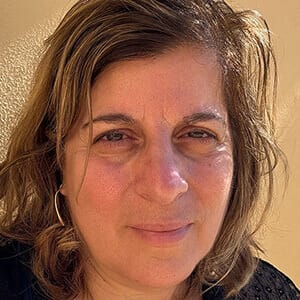
As CEO of OpenAIRE, I lead efforts to build and sustain trusted open infrastructures for research, working closely with institutions, policymakers, and communities to enable transparent, data-driven, and equitable science across Europe.
Your interest in STEM
My first role models were my parents. They instilled in me a strong work ethic, a deep sense of ethics, and a natural commitment to fairness and inclusion. Today, I am inspired by leaders who not only have vision, but also get things done, those who turn ideas into action and deliver real impact.
Your studies
Transitioning from a Physics degree in Greece to a Master’s in Electrical and Computing Engineering in the US was a significant challenge. I had to quickly adapt to a new academic and cultural environment, while catching up on courses and technical areas I had not previously covered. At the same time, I was often in classes where the vast majority were men, many of whom already had industry experience, which made the learning curve even steeper.
Be confident in your abilities and do not let the environment define your potential. Stay curious, invest in building both strong fundamentals and practical experience, and do not hesitate to ask questions or seek support. And cultivate your soft skills, which are often what make the real difference. The ability to communicate clearly, collaborate effectively, and present your ideas with confidence is key to succeeding in this field.
You at work
My organisation is quite diverse, in terms of gender, discipline (from Computer Science to humanities), country (spread across Europe). We do not have particular initiatives. We give opportunities to the young people, as they are the future.
I am most proud of transforming OpenAIRE from a 3 year European project in 2008 into a sustainable organisation with a strong network of over 60 member universities. Equally important to me is having chosen a career that contributes to the public good (open science, science-technology-innovation) while working with diverse communities and partners across the world.
Your point of view
Technology empowers women by giving them access to knowledge, education, and global opportunities, while remote work creates new flexibility. But this only works if women take an active role in shaping the future they want to be part of.
Stay curious, be confident, and focus on building both knowledge and practical experience. Develop expertise in an area that excites you. At the same time, strengthen your soft skills, as the ability to communicate, collaborate, and adapt is key. Finally, reflect on your personal priorities and create space for both your career and your life outside of work.
By 2030, DEIS should no longer need defending. Equal salaries should be a given, and subtle sexism a thing of the past. The real test is simple: does the system reflect fairness in how people are hired, promoted, and heard? If not, it needs to change.
To finish with
Respect, transparency, integrity, and accountability. I value openness in how we work, fairness in how we treat people, and a strong sense of responsibility towards the public good.
One of my key challenges is learning to create more balance, working less while maintaining focus on what truly matters. This means prioritising better, delegating effectively, and ensuring long-term sustainability in how I work.
By 2030, I hope to have grown into a role with broader impact, while working in a more balanced and sustainable way. I would like to focus on what truly matters, support others in their growth, and continue contributing to initiatives that serve the public good.
The current activity has been implemented in the framework of the Project: Code4Europe,
GA Number: 101158834. Official project website : https://codeweek.eu/