

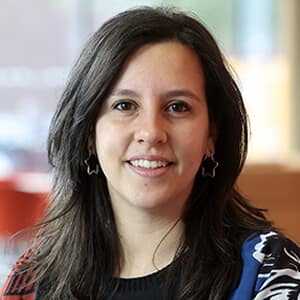
My interest in STEM started at home, long before I knew what the acronym meant. My dad worked as a programmer and was passionate about informatics, so he was the first person to explain to me what a computer was and what it could do. As I grew older and started to show a genuine curiosity about technology and how things work, both my dad and my mum consistently encouraged me to follow that interest. Their support and enthusiasm for my curiosity were key in my decision to study Computer Science and Engineering, which became the foundation for my career in robotics and human-robot interaction.
Your organization field and mission:
Cardiff University’s key sectors are arts, humanities and social sciences, biomedical and life sciences, and physical sciences and engineering, and its mission is to create and share knowledge and educate for the benefit of all.
Please tell us briefly about your role in the company / at your organization:
At Cardiff University, I am a Lecturer (Assistant Professor) in Computer Science and Deputy Director for Equality, Diversity and Inclusion at the School of Computer Science and Informatics. I lead research projects on robotics and AI in health and social care, and I am Co‑Investigator and Executive Board member of the UK Robotics and Autonomous Systems (UK‑RAS) Network.
Your interest in STEM
My first role model was my dad. He showed me how exciting technology could be and encouraged me to believe that I could build a career in this field. As my career developed, I found new role models, including my late PhD supervisor, Professor Penelope Standen, whose dedication to improving the lives of people with learning disabilities through technology deeply influenced my work and values. Today, I am inspired by anyone who is bold enough to innovate, challenge the status quo, and follow their dreams, especially in ways that make STEM more inclusive and socially impactful.
Your studies
During my studies, one of my biggest challenges was dealing with self‑doubt and being made to feel I was not good enough, often linked to being a woman in STEM. Following a non‑traditional path (doing a part‑time PhD while working full‑time, after time in industry) and not fitting the ‘expected’ academic trajectory meant I was repeatedly required to prove my worth and fight stereotypes, while living in another country and away from my main support network. At the same time, I faced periods of job insecurity and delayed building a family until I felt more stable and established in my field. These challenges were difficult, but they also strengthened my resilience and now drive my commitment to making academic careers more inclusive and supportive for others.
My advice to girls and women who want to study in my sector is: your curiosity and motivation are enough reason to be here, even if you do not fit the stereotype. Seek out mentors, peers and communities that support you, and remember there is no single ‘right’ path into robotics, AI or computer science. Your perspective as a woman is not a weakness but a strength the field needs to create more inclusive technologies.
You at work
At Cardiff University there is a strong institutional focus on Equality, Diversity, Inclusion and Sustainability, with university‑wide EDI policies, awareness training and a clear sustainability strategy. In my School, I contribute as Deputy Director for EDI, and I am part of the management team for EMPOWER, a university-wide network supporting current and aspiring women Principal Investigators. My research on accessible, human‑centred robotics and AI also supports the University’s inclusive and sustainable innovation goals.
I am proud of every step I have taken in my career, and I am actively learning to recognise and celebrate each achievement instead of playing them down. I am especially proud of being a mum in a demanding field like robotics and AI, and of showing that it is possible to build a research career while caring deeply about family. I am also proud that my work and leadership roles focus on making robotics and AI more inclusive and accessible, and on helping create a more supportive environment for the next generation of diverse researchers.
Your point of view
Technology can empower women by giving them flexible access to education and skills, opening up new career and leadership opportunities, and connecting them with supportive networks and role models. When designed in a human‑centred and inclusive way, it also amplifies women’s voices and needs, enabling them to shape the technologies and decisions that affect their lives.
My advice to girls and women who want to work in this sector is to back your skills and keep learning, even when others underestimate you. Look for workplaces, teams and leaders whose values align with yours and where you feel respected, and do not be afraid to change environments that hold you back. Build and nurture your network (mentors, collaborators and peers) and remember that your lived experience and ideas are exactly what we need to create robotics and AI that work for everyone.
I would like DEIS in robotics and AI to move from isolated initiatives to being built into how we design technologies, build teams and measure success. By 2030, I want diverse voices, including women and other under‑represented groups, to be genuinely represented and empowered at every level of the sector, from students to leadership, so that our systems are fair, trustworthy and sustainable for the people and communities they serve.
To finish with
My core values are curiosity, empathy and integrity. I care about using robotics and AI in human‑centred, inclusive and accessible ways, and I value collaboration and community so others can thrive.
One of my main future challenges is growing my family while living in another country, away from my own support network, and at the same time continuing to establish myself as a leader in my field. Balancing these two ambitions in a demanding, fast‑moving sector will require setting clear boundaries, building strong local support systems and advocating for more family‑friendly, inclusive practices in academia and robotics.
I hope that by 2030 I will have consolidated my position as a recognised leader in human‑centred robotics and AI, ideally progressing towards (or into) a professorial role. I would like my work to have a clear impact on how accessible and inclusive technologies are designed and deployed, and to be in a position where I can use my experience to support and mentor the next generation of diverse researchers and practitioners in the field.
The current activity has been implemented in the framework of the Project: Code4Europe,
GA Number: 101158834. Official project website : https://codeweek.eu/