

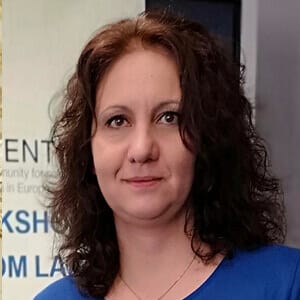
My interest in STEM comes from my background as a chemical engineer and teacher of Chemistry and Information Technologies. I am fascinated by the connection between science, technology and real-world problem solving. Working with students in robotics, programming and digital technologies has shown me how STEM can inspire young people to be curious, creative and confident in finding solutions.
Your organization field and mission:
PG “Prof. Dr. Asen Zlatarov” – Vidin is a vocational school and a Centre of Excellence in vocational education and training. It provides modern, technology-rich education in technical fields such as robotics, computer systems and technologies, electrical engineering, electronics and energy. The school has a high-tech learning environment with specialised laboratories and equipment that support STEM education, innovation and practical, project-based learning. Its mission is to prepare young people with the knowledge, digital and engineering skills, creativity and confidence they need for successful careers and for the challenges of the future.
Please tell us briefly about your role in the company / at your organization:
I am a Deputy Principal and also a teacher of Chemistry and Information Technologies at PG “Prof. Dr. Asen Zlatarov” – Vidin. I work with students in STEM education, robotics and digital technologies, using project-based and interdisciplinary approaches. For almost 20 years, I have been organising and leading educational events and activities related to programming and digital technologies. I am a Leading Teacher in EU Code Week and actively promote students’ interest in technology, programming and innovation.
Your interest in STEM
From an early age, I have been fascinated by scientists and inventors from the past and by how many ideas and discoveries they created with the limited resources available in their time. Leonardo da Vinci is a particular inspiration to me because of the way he combined science, art, engineering and curiosity about the world. Over time, my role models have expanded to include different colleagues, professionals and people whose interesting ideas and projects I have discovered through books, the Internet and my constant search for new knowledge. The book The Innovators has also influenced me, especially the stories of pioneers in programming, including Ada Lovelace.
Your studies
I have always loved challenges. I grew up in a family of engineers, so technology has always been part of my world. As a child, I loved building and creating mechanical things. My interest in computers and programming came much later and developed gradually. I got my first computer around the 10th grade, and programming at that time was quite different from what fascinates me today.
For me, the real magic of programming is not simply writing code and getting a result on a screen, but seeing the code come to life – actually making a mechanism, a robot or another device move and work. I discovered this later through LEGO robotics and Arduino, and it challenged me to keep learning more and more.
One of my challenges has been that I often had to teach myself through books, the Internet, extensive reading and experimentation, without having someone to guide and support me. But when you reach a solution on your own and understand how something works, the satisfaction of learning is much greater.
What inspires me most is combining different fields. As a chemical engineer, I learned that a solution rarely belongs to just one area of science – chemistry, physics, mechanics, mathematics, biology and technology complement and depend on each other. Today, this interconnectedness continues to inspire me, and I try to pass this curiosity on to my students.
Do not be afraid to challenge yourself and try! Being an engineer, programmer or technology specialist is not a “man’s job”. The history of programming itself shows this – the first published algorithm intended to be processed by a machine was written by a woman, Ada Lovelace.
I believe women can be excellent engineers, programmers and designers. We often look at problems from different perspectives and combine ideas in unexpected ways, which can lead to original and inventive solutions. We should not limit ourselves by thinking that because something is related to technology, it is meant for men.
In my work as a teacher, I have rarely met girls who show an interest in technology and programming from an early age. I believe this is also related to stereotypes that have been passed down through generations. That is why it is important to encourage girls to try, experiment and discover for themselves how much they can achieve. They do not need to know everything from the beginning – what matters is having the courage to start, make mistakes, look for solutions and keep going. Once they overcome their initial hesitation, they can discover how interesting, creative and rewarding it is to create with technology.
You at work
Over the years, I have organized different events both within our school and for students from other schools, focused on technologies such as Arduino, Scratch, LEGO and micro:bit. I have also organized initiatives encouraging girls to explore programming and technology. I try to create opportunities for students to experiment, build, and see how technology can be connected to real-life ideas and problems.
At the moment, we are working on an international project for a hydroponic system controlled by an electronic system, which is another example of how different areas of knowledge and technology can be connected.
What I am most proud of is the community I have managed to build around robotics and technology at my school. About 10 years ago, when I started developing the club, I could barely gather 4–5 students. Today, there are more than 20. For me, it is more than just a club – it is a space beyond the usual school environment where students can experiment, create, learn from each other and discover their own potential.
Your point of view
Technology can empower women by giving them confidence, knowledge and opportunities to create and achieve things they may have once considered out of reach. It broadens their horizons and encourages creativity, problem-solving and continuous learning. For me, technology has never been something defined as “for men” or “for women” – it has simply been something I enjoyed exploring and creating with. It also brings together many different fields, from science and engineering to art and design, helping people develop a much broader set of skills. I believe girls should be encouraged from an early age to explore technology, experiment and discover what they are capable of, rather than being guided by stereotypes about which professions are “for women” or “for men”.
My advice is simple: follow your dreams and do not see technology as a “male territory”. Engineering, technology and programming are not professions reserved for men. Women can be equally good engineers, programmers and designers, and their creativity and different ways of thinking can be a great advantage. The most important thing is to challenge yourself, try and not give up just because something seems difficult or unusual. Confidence comes when you see for yourself that you can do it.
By 2030, I would like to see more young people interested in creating, experimenting and developing through technology, rather than simply consuming it. I would like engineering, robotics and technology to become more accessible and attractive from an early age, with equal encouragement for both girls and boys. I also hope we will find the right balance between artificial intelligence and human creativity, so that technology helps us develop our natural abilities rather than replace them.
To finish with
My core values are curiosity, lifelong learning, creativity, inspiration, perseverance, collaboration and respect. I believe we should remain curious, keep developing and never be afraid to try new things. It is also important to me to share my knowledge, inspire others and work with people from whom I can learn something new.
My biggest professional challenge is constantly adapting to new generations and rapidly developing technologies. Artificial intelligence, the Internet of Things, and new educational solutions such as LEGO® Education Computer Science & AI, which are also entering competitions, require me to continuously learn and develop my knowledge. Sometimes this means becoming a beginner again and learning alongside my students. For me, this is a challenge, but also one of the most exciting parts of my profession.
By 2030, I hope to have successfully adapted to new technologies, artificial intelligence and new generations of students, and to have found the right balance in working with all of them. For me, the challenge is that with every new technology, I become a beginner again rather than simply building on what I already know. But this is exactly what keeps me learning and developing. I hope that in four years I will have found my own “recipe” for combining technology, artificial intelligence and human creativity in my work with students.
The current activity has been implemented in the framework of the Project: Code4Europe,
GA Number: 101158834. Official project website : https://codeweek.eu/